3PL warehouse automation needs more than vehicles when clients, peaks and nodes keep changing.
Third-party logistics projects often face multi-client workflows, peak volatility, tight labor pressure and brownfield constraints. That usually means AGV works best when task logic, dispatching, WMS/WCS and rollout sequencing are considered together.
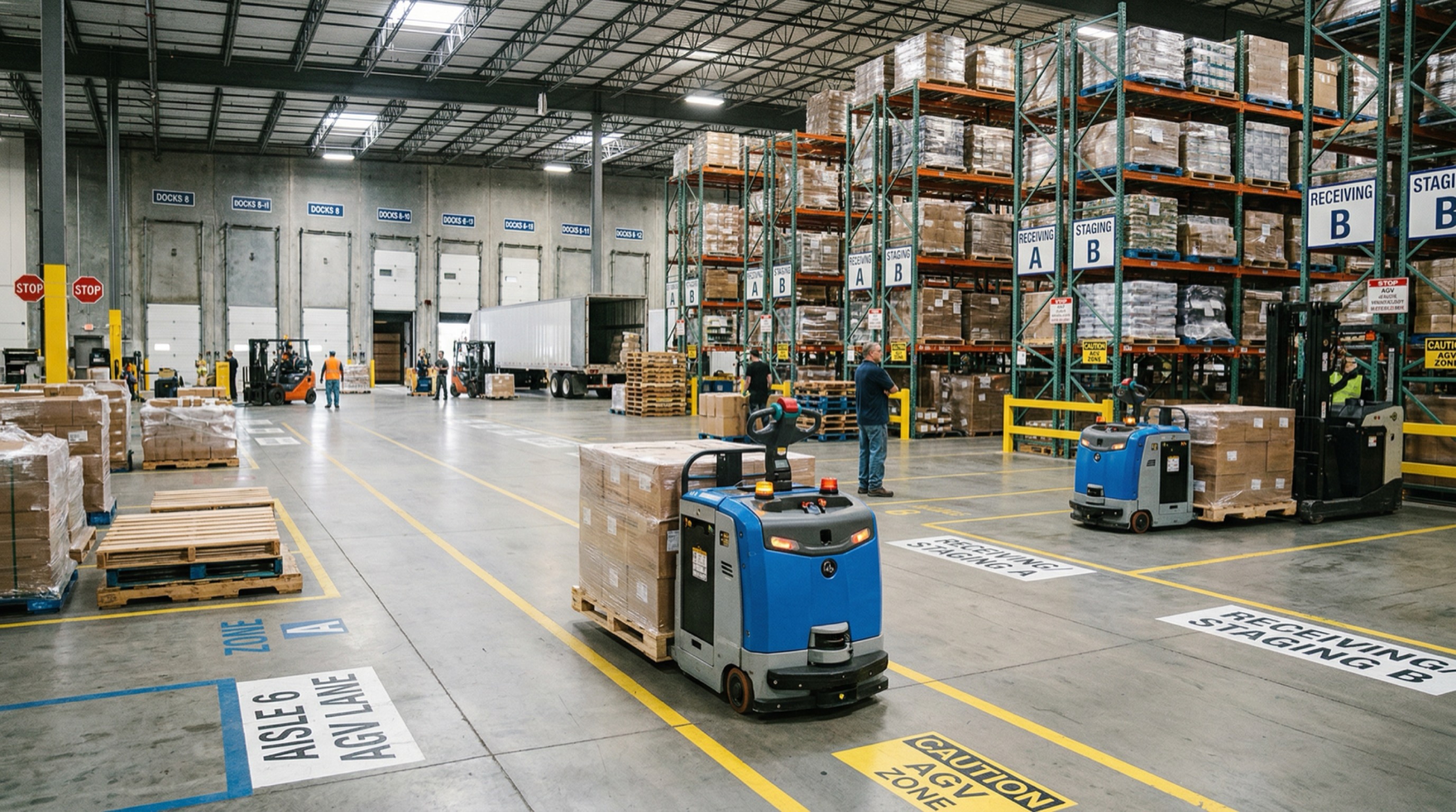
These are the signals that make 3PL automation more system-sensitive
- Several customers, several order profiles and several service rules share the same warehouse operation.
- Peak seasons and campaign periods create throughput swings that manual dispatch struggles to absorb.
- Warehouse zones, staging, replenishment and outbound sequencing all compete for priority.
- Labor pressure pushes the site toward more predictable, repeatable internal transport.
- The site often cannot stop and rebuild everything, so phased brownfield rollout matters.
- A later scale-up path is usually required across more zones, more tasks and more client complexity.
Where AGV and system coordination usually create the most value in 3PL
Pallet movement between zones
Receiving, storage, staging and outbound loops that repeat every shift and need more stable throughput.
Replenishment and queue-heavy operations
Sites where multiple handoff points and replenishment timing create dispatch pressure.
Brownfield sites with growing complexity
Operations that must start from one stable workflow first, then expand into more zones and clients.
In 3PL, the stronger projects usually align these four layers
Physical workflow
Repeatable routes, handoff points and transfer rhythm that are worth automating first.
AGV execution
Vehicle choice, safety constraints, pickup/drop requirements and internal route logic.
Dispatch and control
Task release, queue logic, multi-vehicle coordination and operational priority control.
Upper-layer system fit
WMS, WCS, ERP and reporting logic that keep execution aligned with service requirements.
These are the best low-friction ways to start a 3PL automation discussion
Free workflow diagnosis
Share your current client mix, task types, peak pattern and system situation. We will judge the safest first automation path.
Free system maturity check
We assess whether your current ERP/WMS environment can support AGV coordination or needs stronger WCS/WMS design first.
Free rollout priority suggestion
We identify which zone, route or workflow should be piloted first to reduce risk and create a base for later scale-up.
Use these pages next if your 3PL project already has a clearer system or workflow question
System integration path
For sites that already know ERP, WMS, WCS, dispatching or status feedback is the real constraint.
Free workflow diagnosis
For teams that want a quick judgement on rollout priority, system maturity and the safest first scenario.
RFID flat-warehouse case
For 3PL or overflow sites that need scan points, batch identity and lower-vehicle operation across a wider floor area.
System-led case example
For buyers who want to see how coordination, visibility and execution can be explained in one operational story.
If your 3PL site is already under labor or peak pressure, start by clarifying the workflow and system fit
Tell us about your current warehouse zones, task profile, client complexity, system stack and rollout constraints. We can then judge whether the best path is AGV first, WCS first, or a broader WMS/WCS structure from the start.